
Native Snails
The Abel Tasman is home to two species of endangered snails. Never before have they been studied so intensively with monitoring and survey results painting a rosier picture about their populations than previously thought.
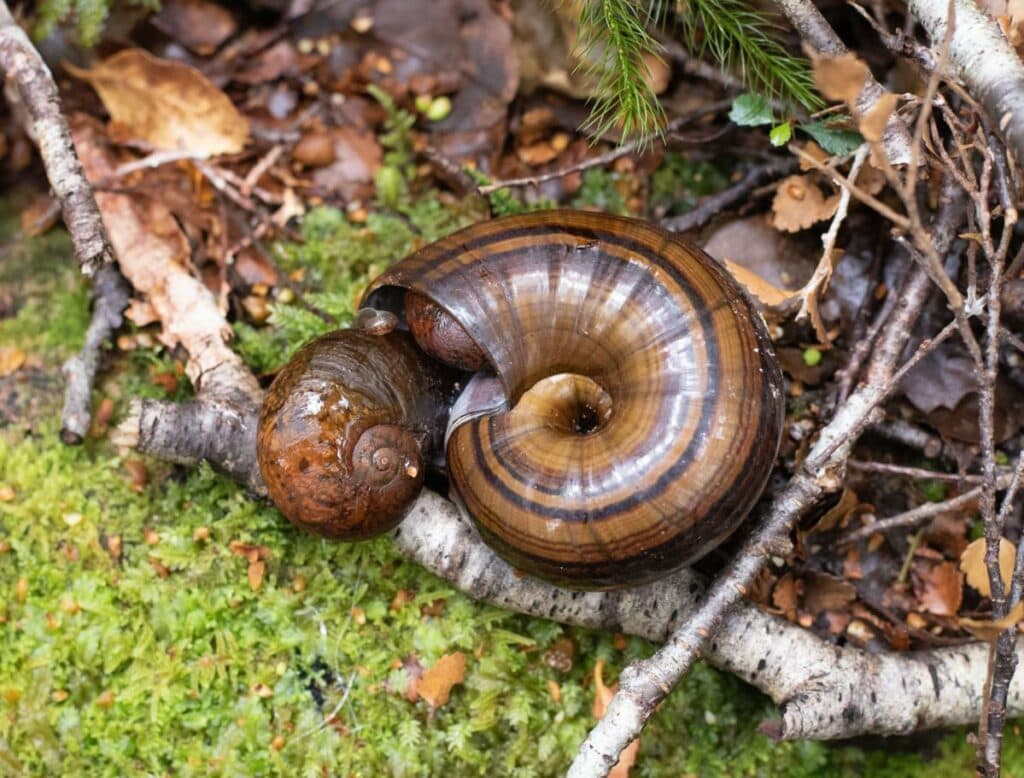
New Zealand’s Endangered Snails
Project Janszoon has been monitoring endangered land snails to assess the threats of climate change and predation by introduced pests.
New Zealand’s land snails are as unique as kiwi, kakapo and tuatara. They are carnivorous and hunt at night for worms and other critters, but they are also endangered species. Introduced pests like possums, rats, hedgehogs and thrushes all have snails on the menu. Environmental changes due to climate change and the recent recovery of weka populations in the area is also starting to impact our native snail populations.Project Janszoon Scientific Advisor Ruth Bollongino has monitored the endangered land snail populations of Powelliphanta hochstetteri and Rhytida oconneri in the Canaan and Wainui areas. R. oconneri is of particular importance as it is only found on Takaka Hill and a few places in Golden Bay. Ruth used nocturnal mark-recapture – an intensive monitoring method that collects data about population size and demographic data like age structure, mortality and recruitment.
Powelliphanta Hochstetteri
This carnivorous land snail is the largest snail in the world and found in the upper reaches of the Park, Wainui Valley and Falls River catchment.
In a first for New Zealand, in the spring of 2016 Dr Brian Lloyd–assisted by Dr Ruth Bollongino–attached tiny radio transmitters to ten Powelliphanta hochstetteri snails near Canaan Downs to investigate their ranging behaviour and activity. The snails in this study were from the sub-species P.h. hochstetteri, ranked as in gradual decline. They were monitored, day and night for the next 41 days.
This is the first time snails had been radio-tracked at night in New Zealand, giving a unique insight into the carnivorous land snail’s behaviour. Results found snails are active for one or two nights and then have longer periods of inactivity, preferring to move on warm, moist nights. Unsurprisingly they don’t travel great distances, on average just 1.32m, although one did travel 3.8m.
Interestingly, the snails tended to move in a straight line with a slight left bias. None went back to the same spot, which indicates they are not territorial and don’t seem to have a home base.
The information from the snail tracking will help improve the accuracy and precision of population estimates from mark-recapture and other survey methods. Two hundred snails were also tagged and monitoring will be repeated to survey population changes over time.
Learn more about Powelliphanta hochstetteri
Rhytida Oconnori
Rhytida oconnori is the only critically endangered species found in the Abel Tasman and numbers were thought to be in decline. However monitoring by DOC and Project Janszoon in 2015 found the population is much more widespread in the Park than initially thought.
To put this in context, according to DOC biodiversity ranger Mike Ogle, if the Rhytida oconnori had feathers it would be the equivalent of a kakapo – as they are both classified nationally critical. Imagine finding you had 20 percent more kakapo than you’d previously thought? People would be popping the champagne corks!
(Photo Fred Overmars)
Learn more about Rhytida oconnori

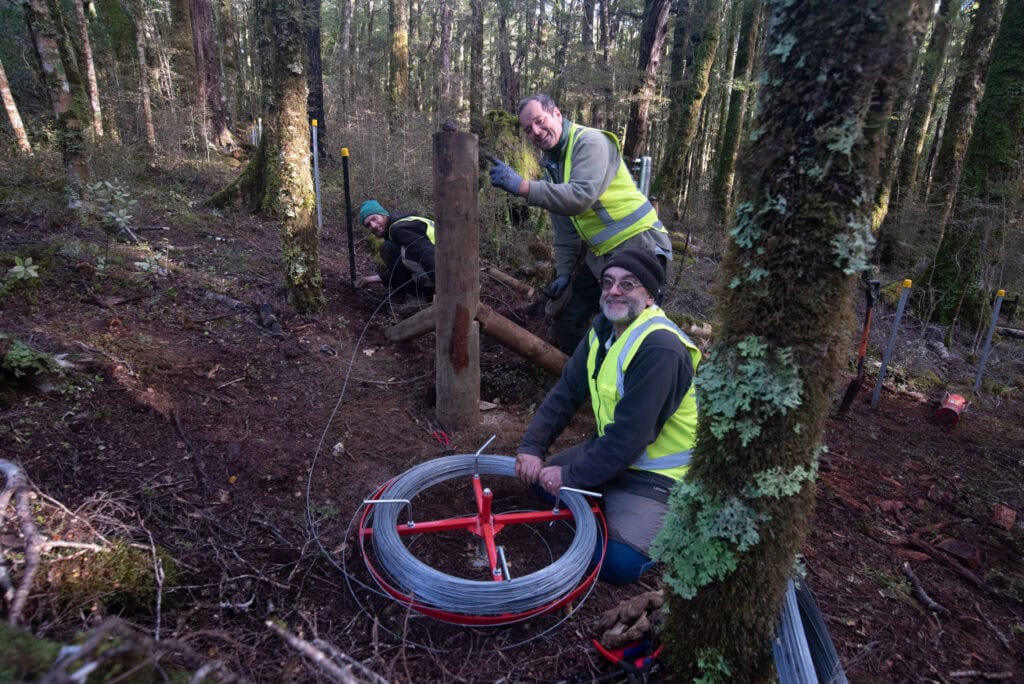
Snail sancturies
In 2022 Project Janszoon built two snail sanctuaries at the top of the park at Wainui and Pisgah to protect Powelliphanta and Rhytida oconnori native snails from weka.
Our monitoring showed weka had caused a rapid snail decline of over 60% per annum, meaning these species would have been driven to extinction in the park within a few years. The fences are 70×70 m in size and keep weka and pigs out.
Monitoring has shown a strong signal of snail recovery. As part of the Tomorrow Accord DOC has committed to maintaining these snail sanctuaries into the future.